Powered By Blogger

Wednesday, February 16, 2011

Yanni.....The Musician


Yanni (born Yiannis Hrysomallis (pronounced Chrysomallis), (Greek: Γιάννης Χρυσομάλλης, classical transcription Giannis Chrysomallis), on November 14, 1954, in Kalamata, Greece) is a self-taught pianist, keyboardist, and composer.

He earned Grammy nominations for his 1992 album, Dare to Dream, and the 1993 follow-up, In My Time. His breakthrough success came with the 1994 release of Yanni Live at the Acropolis, deemed to be the second best-selling music video of all time. Yanni has since performed live in concert before in excess of two million people in more than 20 countries around the world. He has accumulated more than 35 platinum and gold albums globally, with sales totaling over 20 million copies. Yanni is considered to be one of the top fundraisers of all time for public television. His compositions have been included in all Olympic Games television broadcasts since 1988, and his music has been used extensively in television and televised sporting events. His music is frequently described as "new age", though he prefers the term "contemporary instrumental".

Studio Albums

Live albums/videography

Soundtracks

Compilations

Other credits

Concert tours


Tuesday, July 13, 2010

David Garrett


David Garrett (born September 4, 1981, Aachen, Germany[1]) is a German-American classical violinist and recording artist.Garrett was born in Aachen, Germany to an American mother and a German father.

When Garrett was four years old, his father bought a violin for his older brother. The young Garrett took an interest and soon learned to play. A year later, he took part in a competition and won first prize. By the age of seven, he was playing once a week in public. He studied violin at the Lubeck Conservatoire. At the age of 12, Garrett began working with the distinguished Polish violinist Ida Haendel, often traveling to London and other European cities to meet her.[2]

At the age of 13, Garrett recorded two CDs, appeared on German and Dutch television, and gave a concert in the residence of the Federal Republic of Germany President, the Villa Hammerschmidt, at Dr. von Weizsäcker’s personal invitation. He was offered the use of the famous Stradivarius "San Lorenzo", which is among the best instruments of the "golden period". At the age of 14, as the youngest soloist ever, Garrett signed an exclusive contract with Deutsche Grammophon Gesellschaft. Aged 17, he played with the Munich Philharmonic Orchestra under the direction of Zubin Mehta in Delhi and Mumbai in concerts marking the 50th anniversary of India’s Independence. [3]

Two years later, Garrett played with the Rundfunk-Sinfonieorchester in Berlin, under the direction of Rafael Frühbeck de Burgos, and was hailed by critics. This led to an invitation to perform at Expo 2000 in Hannover. He continued his studies at the Royal College of Music in London. At the age of 21, he was invited to perform at the BBC Proms. He graduated from the Juilliard School in 2004.

While studying at the Juilliard School in New York City, as one of the first students to study with Itzhak Perlman, Garrett supplemented his income by working as a model.

Studio Albums

Other Albums

Featured

Live DVD

Awards


Garrett's latest release of "Encore" at DECCA pursues an aim of arousing young people’s interest in classical music. The release contains arrangements and compositions of his own of pieces and melodies that have accompanied him in his life so far.

Together with his band, consisting of keyboard, guitar and drums, he gives concerts that include classical sonatas (accompanied by a concert grand piano), arrangements, and compositions, as well as Nothing Else Matters by Metallica which was performed on the Public Broadcasting Service (PBS) presentation "David Garret: Live in Berlin" recorded in January of 2009. [5]

In Autumn 2007, Garrett was chosen by the “Montegrappa” firm (whose articles are distributed by Montblanc throughout the world) as an ambassador for the launch of the new pens from the "Tributo ad Antonio Stradivari" collection. The event will take place in several different venues, including Rome, New York, Hong Kong, Berlin, and London. On this occasion, Garrett has been offered a Stradivarius from the “Gli Archi di Pallazzo Comunale” collection.[6]

Garrett also joined the 9th annual Independent Music Awards judging panel to assist independent musicians' careers.

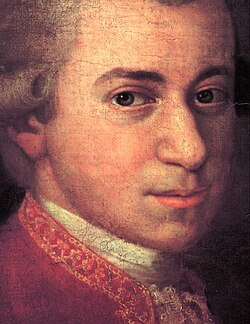
Mozart


Wolfgang Amadeus Mozart , baptismal name Johannes Chrysostomus Wolfgangus Theophilus Mozart[1] (27 January 1756 – 5 December 1791), was a prolific and influential composer of the Classical era. He composed over 600 works, many acknowledged as pinnacles of symphonic, concertante, chamber, piano, operatic, and choral music. He is among the most enduringly popular of classical composers.

Mozart showed prodigious ability from his earliest childhood in Salzburg. Already competent on keyboard and violin, he composed from the age of five and performed before European royalty; at 17 he was engaged as a court musician in Salzburg, but grew restless and traveled in search of a better position, always composing abundantly. While visiting Vienna in 1781, he was dismissed from his Salzburg position. He chose to stay in the capital, where he achieved fame but little financial security. During his final years in Vienna, he composed many of his best-known symphonies, concertos, and operas, and the Requiem. The circumstances of his early death have been much mythologized. He was survived by his wife Constanze and two sons.

Mozart learned voraciously from others, and developed a brilliance and maturity of style that encompassed the light and graceful along with the dark and passionate. His influence on subsequent Western art music is profound. Beethoven wrote his own early compositions in the shadow of Mozart, of whom Joseph Haydn wrote that "posterity will not see such a talent again in 100 years."

Wolfgang Amadeus Mozart was born to Leopold and Anna Maria Pertl Mozart at 9 Getreidegasse in Salzburg, capital of the sovereign Archbishopric of Salzburg, in what is now Austria. At the time it was part of the Bavarian Circle in the Holy Roman Empire. His only sibling to survive past birth was Maria Anna (1751–1829), called "Nannerl". Wolfgang was baptized the day after his birth at St. Rupert's Cathedral. The baptismal record gives his name in Latinized form as Joannes Chrysostomus Wolfgangus Theophilus Mozart. He generally called himself "Wolfgang Amadè Mozart"[3] as an adult, but there were many variants.

His father Leopold (1719–1787) was from Augsburg and deputy Kapellmeister to the court orchestra of the Archbishop of Salzburg, and a minor composer. He was also an experienced teacher. In the year of Mozart's birth, his father published a violin textbook, Versuch einer gründlichen Violinschule, which achieved some success. When Nannerl was seven she began keyboard lessons with her father, and her three-year-old brother would look on, evidently fascinated. Years later, after his death, she reminisced:

He often spent much time at the clavier, picking out thirds, which he was always striking, and his pleasure showed that it sounded good. [...] In the fourth year of his age his father, for a game as it were, began to teach him a few minuets and pieces at the clavier. [...] He could play it faultlessly and with the greatest delicacy, and keeping exactly in time. [...] At the age of five he was already composing little pieces, which he played to his father who wrote them down.

Beethoven


Born in Bonn, which was then capital of the Electorate of Cologne and a part of the Holy Roman Empire of the German Nation in present-day Germany, he moved to Vienna in his early twenties and settled there, studying with Joseph Haydn and quickly gaining a reputation as a virtuoso pianist. His hearing began to deteriorate in the late 1790s, yet he continued to compose, conduct, and perform, even after becoming completely deaf.

Beethoven was the grandson of a musician of Flemish origin named Lodewijk van Beethoven (1712–1773).[2] Beethoven was named after his grandfather, as Lodewijk is the Dutch cognate of Ludwig. Beethoven's grandfather was employed as a bass singer at the court of the Elector of Cologne, rising to become Kapellmeister (music director). He had one son, Johann van Beethoven (1740–1792), who worked as a tenor in the same musical establishment, also giving lessons on piano and violin to supplement his income.[2] Johann married Maria Magdalena Keverich in 1767; she was the daughter of Johann Heinrich Keverich, who had been the head chef at the court of the Archbishopric of Trier.[3]

Beethoven was born of this marriage in Bonn; he was baptized in a Roman Catholic service on 17 December 1770, and was probably born the previous day, 16 December.[4] Children of that era were usually baptized the day after birth; and it is known that Beethoven's family and his teacher Johann Albrechtsberger celebrated his birthday on 16 December. While this evidence supports the case for 16 December 1770 as Beethoven's date of birth, it cannot be stated with certainty, as there is no documentary evidence of it (only his baptismal record survives).[5][6] Of the seven children born to Johann van Beethoven, only the second-born, Ludwig, and two younger brothers survived infancy. Caspar Anton Carl was born on 8 April 1774, and Nikolaus Johann, the youngest, was born on 2 October 1776.[7]

Beethoven's first music teacher was his father. A traditional belief concerning Johann van Beethoven is that he was a harsh instructor, and that the child Beethoven, "made to stand at the keyboard, was often in tears".[2] However, the New Grove indicates that there is no solid documentation to support it, and asserts that "speculation and myth-making have both been productive."[2] Beethoven had other local teachers as well: the court organist Gilles van den Eeden (d. 1782), Tobias Friedrich Pfeiffer (a family friend, who taught Beethoven piano), and a relative, Franz Rovantini (violin and viola).[2] His musical talent manifested itself early. Johann, aware of Leopold Mozart's successes in this area, attempted to exploit his son as a child prodigy, claiming that Beethoven was six (he was seven) on the posters for Beethoven's first public performance in March 1778.

Ananda College


Ananda College was established by the Buddhist Theosophical Society with the inception by Col. Henry Steele Olcott in 1886 with the prime aim of securing educational Rights of Buddhists. Originally it was known as English Buddhist School describing its stated intention of providing English instruction to Buddhist students who would otherwise have to had to go to a missionary school in order to get an English education.The school was opened on 1st of November 1886 with 37 students in a private house at No. 61 Maliban Street, Pettah as "English Buddhist School". In August, 1889, the school moved to more spacious place at No. 19 Prince Street. In 1895, it was relocated to Maradana and later named "Ananda College" after Arahant Ananda, the most Devoted disple of the Buddha.Ananda has grown to be one of the leading educational institutes today and the pioneer of Buddhist education in Sri Lanka as well as one of the greatest Buddhist schools in Asia. Currently Ananda College provides primary to Advanced level education to over 6000 students across 13 grades on a campus of more than 20 acres. Equipped with the latest facilities and a dedicated academic staff of over 260 individuals , Ananda has shown its success by gifting many great personalities to the country throughout its history.www.ananda.sch.lk - The Official web portal of Ananda College proudly brings to you everything from college History to news on the latest happenings.

Kasun Kalhara